
My Yom Kippur Sermon about facing the truth of your own story as a path to liberation
My Yom Kippur sermon on the idea that there is no such thing as closure, just possibilities of opening and reopening our hearts.
An article about my art journey

For Our Neighbors in Pain
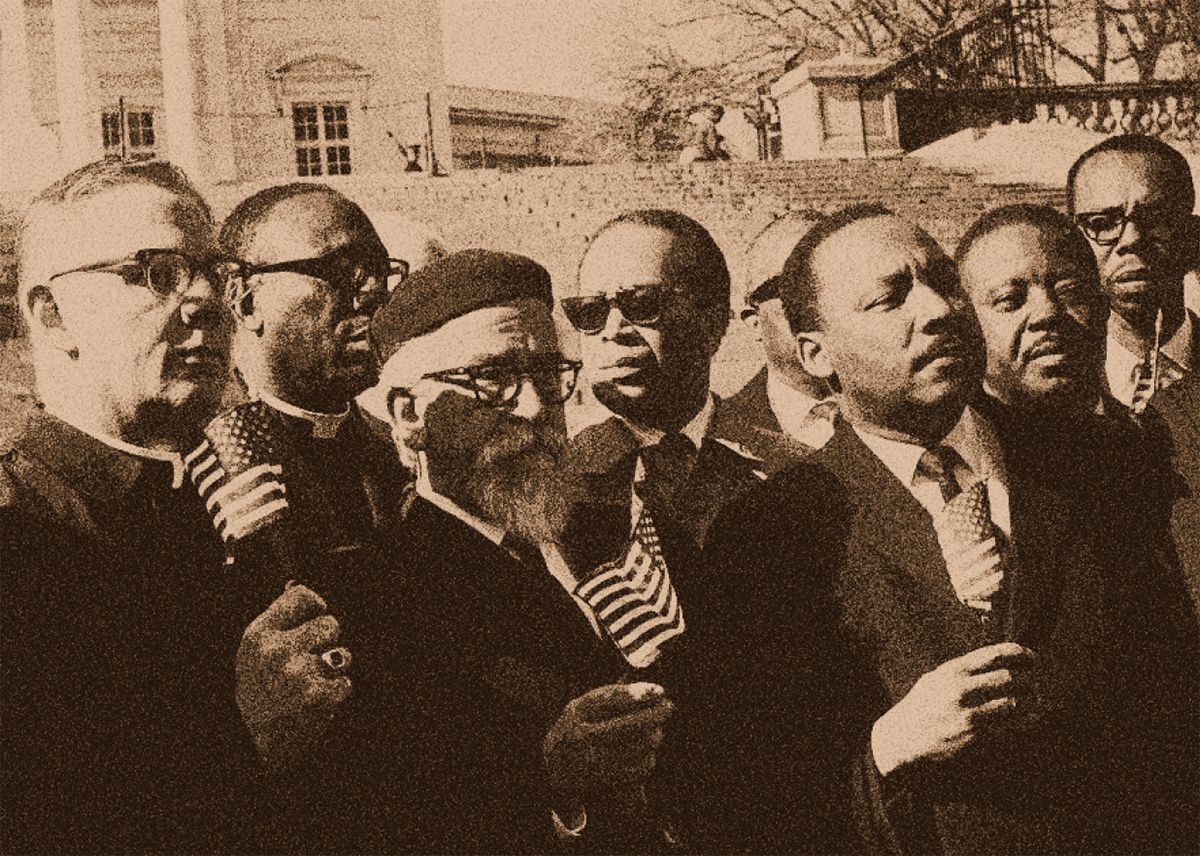
My heart aches for those whose hearts are broken, for those who feel that this country has turned against them, for those who feel that no one cares if their child gets home safely and unharmed, for those who feel that the very systems of our society neglect them, and in fact criminalize them because of who they are and what they look like.
We often recall MLK’s I have a Dream speech in 1963, but I feel that this country is still haunted by Governor George Wallace’s 1963 inaugural speech, “In the name of the greatest people that have ever trod this earth, I draw the line in the dust and toss the gauntlet before the feet of tyranny, and I say segregation now, segregation tomorrow, segregation forever.” MLK, in fact, wrote his speech in reaction to Wallace.
The black community in America has continuously experienced terrible forms of racism, including redlining and overt attacks like lynchings. I remember the events in Detroit of 1967, and if you had told me that in 2020 we would still be facing issues of racism, discrimination and intolerance at the levels we are seeing now, I would not have believed it. Detroit had literally built brick walls, so whites would not have to see blacks. Is there any clearer expression of contempt? Is there any wonder at how much hurt and pain that caused?
There has been a great deal of discrimination against other groups in America, but only the black community was brought to America involuntarily. If you say that was a long time ago, and why keep bringing that up, what are you going to say to the people who said the Holocaust was a long time ago, and why do we keep bringing it up? Pain that never heals becomes a generational affliction, both to the victim and to the perpetrator. As a people who have suffered so much, we should be the most empathetic to the suffering of others.
Our sages understood that a society collapses if there is no trust in government and its ability to create justice. In Pirkei Avot, Rabban Shimon ben Gamaliel used to say: “on three things does the world stand: On justice, on truth and on peace, as it is said: ‘execute the judgment of truth and peace in your gates’ (Zechariah 8:16).”
The purpose of a justice system is to make sure that everyone without exception has their rights upheld and has the full protection of that system during the process of arrest, arraignment, trial, and if found guilty, penalty and incarceration. Being accused of a crime should not lead immediately to the death penalty. Most law enforcement officers know this and act honorably and well. The ones who do not must face the justice system. Otherwise, there will never be trust and credibility, there will never be a belief that the system is fair.
There is no excuse for violence or looting, but that does not remove the rights of other people to protest peacefully, which the vast majority have done.
The US Constitution guarantees the right of the people to assemble:
Amendment I
Congress shall make no law respecting an establishment of religion, or prohibiting the free exercise thereof; or abridging the freedom of speech, or of the press; or the right of the people peaceably to assemble, and to petition the government for a redress of grievances.
This was expanded by the Supreme Court in 1876:
United States v. Cruikshank, 92 U.S. 542 (1876). The Supreme Court said that the “right of the people peaceably to assemble for the purpose of petitioning Congress for a redress of grievances, or for anything else connected with the powers and duties of the national government, is an attribute of national citizenship, and as such, under the protection of, and guaranteed by, the United States.”
The Torah tells us to love our neighbors as ourselves. Our sages understand that all of humanity are our neighbors, because each person is loved by God. So many of our neighbors are in pain and need our love and kindness, not our judgment. We suffered throughout history, because others hated us for who we are. We can break that cycle of hate.
I do not have any easy answers or quick fixes. We can start, though, with open minds and ears, and most importantly, open hearts. We can never understand someone’s pain, but we can understand that they are in pain. We can demand justice and accountability from public servants. We can vote for those who stand for justice, and make sure that all voters’ rights are protected. We can donate to causes that reflect our values. We can remember that the Jewish people has always stood with the oppressed and against tyranny and injustice. We are the people of Moses, not Pharaoh.
Dr. King said, “I refuse to accept the view that mankind is so tragically bound to the starless midnight of racism and war that the bright daybreak of peace and brotherhood can never become a reality… I believe that unarmed truth and unconditional love will have the final word.”
Let us fulfill his vision, and that of the Jewish prophet Amos, “Let love and justice flow like a mighty stream.” Let us be the generation that brings this vision to life.
Shavuot and Justice
There is a reason that in the Ten Commandments, whose revelation we celebrate beginning tonight at Shavuot, the commandment of I am the Lord Your God is juxtaposed with Do Not Murder.
The great Jewish philosopher Emmanuel Levinas said that every commandment to not do something implied a commandment to do something. The commandment to not murder means to not allow murder to happen or to allow murderers to go unpunished.
When look the other way at injustice, even if we did not commit a crime ourselves, we remove God’s presence from the world. Standing up for others, standing with others, and standing for justice is not just part of Judaism. It is the very foundational idea. It is how we create the world that God can feel at home in.
This is a painting I did a number of years ago to celebrate the strength and courage of Ethiopian Jewry, who has lifted all of us to greater spiritual heights. It is a reminder that there is no “they” only “us.”
A sweet and joyous and meaningful Shavuot to all.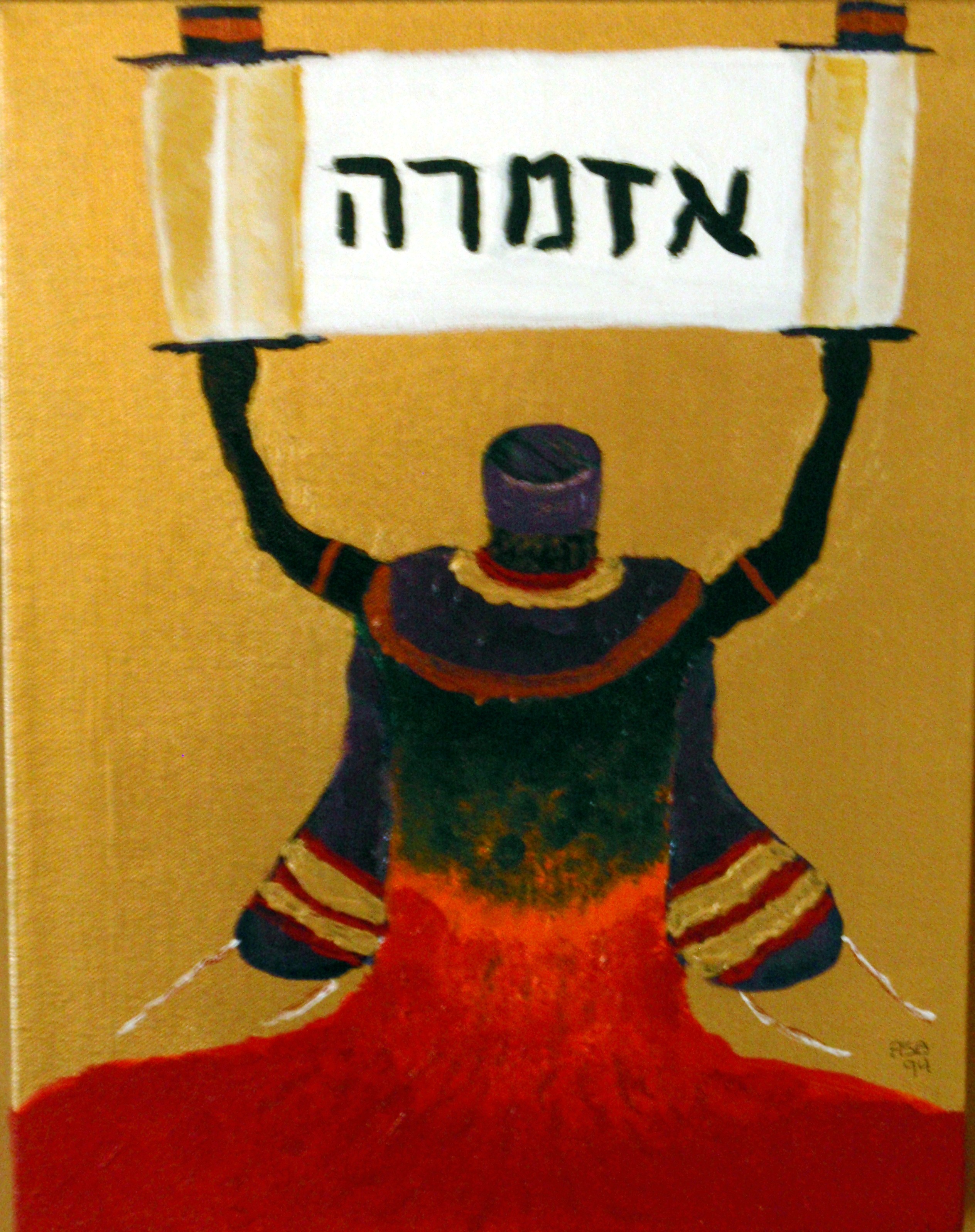
The Real Value of Living a Spiritual Life
Based on The Torah Portion Mishpatim
Many people turn to religion because they have a deep spiritual hunger, and feel there is a hole in their heart or in their soul. They believe there are answers to life’s mysteries and solutions to all our problems. If we just prayed enough, or studied enough we would achieve enlightenment and perfect equanimity. We would never get angry again or sad. The world would no longer be scary.
Among this group are people who had one incredible spiritual moment, when everything came together and made sense.
They spend the rest of their lives chasing that feeling, but are usually frustrated. They believe if they could recreate that moment, all their problems would be solved. The moment never returns. Their lives are still confusing, and a day to day struggle to keep up.
This is a challenge even for clergy. Many of us became rabbis or cantors because we had one extraordinary moment, and then dedicated their lives to finding it again for themselves, or at least helping others find theirs. I will admit that I am one of them.
Many of us who pursue more spirituality oriented lives think that we will be enlightened at the end of the process, that we will never be thrown off balance, and that everyone will respond to our enlightenment by doing pretty much everything we say. This rarely happens.
Suzuki Roshi had a great comment. He said there are no enlightened people, just enlightened activities. That is, there is not permanent happy state of mind, only opportunities to be helpful and kind to others, opportunities to fight for the freedom and well being of others.
This is the overall theme of our Torah portion.
People had just stood at Sinai, the greatest revelation of God and spirituality in human history. They probably assumed everything would be perfect from then on. No more messiness, no more difficult relationships, no more real effort.
That is not what happens. In our Torah portion we see that life continued to be and endless series of challenges and dangers and unpredictable events. There are ethical dilemmas that are not solvable, only manageable.
As Jack Kornfeld puts it, after the ecstasy, you still have to do the laundry.
Religion is not about solving and fixing everything. It is not even about understanding everything. If that is what we are waiting to happen, we will wait for the rest of our lives in increased frustration, or we may just abandon the spiritual quest. Any religion or at least religious leader that promises that if you follow all of its tenets you will no longer have problems is either fraudulent or delusional.
I believe that we should try to understand things as much as possible, to make the attempt to understand how the world works, what motivates people and what matters most to us. We should study history and science and psychology and art. At some point though, we have to give up the idea that we can understand why everything happens, especially things that are painful. For some situations, there will never be satisfying answers.
What then is the ultimate value of religion? I cannot speak on behalf of other faiths. I would like to share what it is about Judaism that I find so helpful.
Judaism to me is about having the courage and strength to face those challenges, and the kindness and compassion to help other people face theirs. It is about knowing that we are part of a people who stood together at Sinai, and then struggled through an uncertain future together, until they made it into the promised land. And even then, they knew their work was not done. They knew that life is not a mystery to be solved, but an opportunity for growth in wisdom and kindness, for appreciating the treasure of our lives, and for helping others, both our loved ones and strangers, to live meaningful and loving lives.
On the 50th Yahrtzeit of MLK
I grew up in Oak Park, and went to Einstein elementary school. If you went there, you knew one of the best things about it was Mrs. Halsey, our school librarian. Mrs. Halsey a great big hug of a woman, warm as sunshine, whose smile made you feel like you mattered. One day when I was in kindergarten she came in very quietly, without a smile, and with tears on her cheeks. What happened, we asked. She said, A man I loved very much died yesterday. Who was so great to make Mrs. Halsey cry? This day was Friday, April 5th, 1968. It was Dr. King who she loved. We cried with her. I wanted to know more about the man who meant so much to her. I learned to love Dr. King, too. I am moved by everything he said, it is his mountain top speech, the last speech he ever gave, that I listen to at least once a year, and I cry each time.
This is from the end of that speech:
Like anybody, I would like to live a long life. Longevity has its place. But I’m not concerned about that now. I just want to do God’s will. And He’s allowed me to go up to the mountain. And I’ve looked over. And I’ve seen the Promised Land. I may not get there with you. But I want you to know tonight, that we, as a people, will get to the promised land!
And so I’m happy, tonight.
I’m not worried about anything.
I’m not fearing any man!
Mine eyes have seen the glory of the coming of the Lord!!
This is the main lesson I learned from Dr. King. We have to have the courage to do what is good and right in the eyes of the lord, even when we are afraid, especially when we are afraid. He taught us that we should work everyday to fulfill the promise of a just and peaceful world, even if that promise is not fulfilled in our life time. He taught us to live the torah’s words, Vahavta, You shall love the Lord your God with all of your heart, with all of your soul and with all of your might. Not someone else’s. Yours. Because of that, He did not just see the glory of the coming of the Lord. He brought the glory of the lord. He was the glory of the lord.
May we live with courage and determination and faith, and we always be worthy of the love that Mrs. Halsey had for Dr. King.
Four Questions to Connect the Generations

Four Questions to Connect the Generations
Elections by nature are always divisive. It is part of the democratic process. This year seems different. There is more anger and frustration than I have seen in a long time.
We are in the middle of one of the biggest generational divides in decades, if not longer. This includes the Jewish community, which is internally divided in so many ways. There is no consensus on issues like Israel, intermarriage, race, gender identity, good financial practices and the role of institutions such as synagogues, schools and federations. There are very few good conversations between people. There is a lot of blaming and yelling, but not a lot of talking.
The Purpose of the Passover seder is to create peace between generations.
It allows us to sit together, to question, to answer, and to listen. The goal is not to agree with each other, but to make room for each other. We put aside our egos and take a genuine interest in each other.
Here are four questions for your Seder to help with the conversation:
1-Who do you think are today’s liberators, our Moses, Aaron and Miriam, and who do you think are today’s oppressors, our Pharoah?
2-What makes a country into an Egypt and what can turn it into a Promised Land?
3-For the older generation, what would the child you were ask the adult you are today? For the younger generation, what will you ask the older person you will become?
4-When have you been wise, when have you been difficult, when have you been confused, and when have you been silent?
Ruth and I and our family wish you a very sweet and happy Pesach.
Purim-Taking ourselves seriously through laughter
A real religion encourages making fun of itself
Every year, a month before Passover, Jews dress up in fun costumes, host parties, deliver tasty packages to friends and give donations to charity. We do all this because it’s actually mandated by the holiday, Purim, which is a Jewish Halloween of sorts – except there are no ghouls or goblins or tricks.
Purim is the day on the Jewish calendar when our brethren around the world dedicate the day to poking fun of our religion, making fun of our rabbis and engaging in parody and satire about the very thing we usually take so seriously: what we believe.
Especially in light of recent current events around the globe, not taking yourself so seriously is an important part of any religion. On Purim, students are allowed to make fun of their rabbis. Congregants make goofy jokes about the liturgy and the tradition. It’s a very light-hearted and celebratory day, tied to the idea that if you take yourself so seriously all the time, it creates a problem.
Every fall, after the solemnity of our Jewish New Year (Rosh Hashanah) and Yom Kippur, the Day of Atonement, which is a 25-hour fast day to avenge our sins, we have another light-hearted holiday called Sukkot. The juxtaposition is no coincidence – sure, we have the serious and the harsh, the contemplative and the reprimand. And then we have the fun.
Balance is key in any organized community. It’s imperative, actually. In Judaism, and in all religions, we have mechanisms built-in so we won’t take ourselves that seriously.
Although it falls on March 5th this year (beginning at sundown on the 4th), Purim is actually the last holiday of the Jewish calendar because Passover is considered the start. That’s the holiday that’s all about God doing everything for us, where the Purim story is about human beings taking some responsibility.
The celebration of Purim is very lighthearted, but the story of Purim itself is quite serious. It takes place after the Babylonians destroyed the First Holy Temple in Jerusalem in 586 BCE and took the Jewish people to Babylonia as captives in exile. The Persians then conquered the Babylonians.
The Jewish people lived safely in Persia for a while until a vicious anti-Semite named Haman tried to convince his King Achashverosh to destroy the Jewish community. Thanks to the bravery of a Jewish woman named Esther and the strategies of her uncle Mordecai, Haman fails and is himself destroyed.
Purim is a reminder of how quickly our safe and comfortable world can be turned upside down by fanatics, and how much diligence and courage is needed to prevent that from happening. Mordecai and Esther took their responsibilities very seriously, but did not take themselves too seriously. They did what was needed.
Part of being responsible includes knowing when to take things seriously and knowing when to let things go. It’s the wisdom of realizing that we shouldn’t fight over everything and that we can laugh at ourselves a little bit.
If a tradition is good, it can take a little poking at. Only insecure people are afraid of parody or criticism. Most religions include built-in checks and balances – while we are responsible for setting an example, doing right, making the world a better place, we can also have fun and enjoy our lives.
Those who are forbidden from criticizing the establishment build up resentments. And at a certain critical mass, those resentments explode.
In one of our sacred texts, Pirkei Avot, which translates as Lessons of the Fathers, we are reminded that rabbis are not to separate from the community. I interpret that as preventing the leaders of a community from building an inflated sense of their own importance.
On Purim, everyone comes together to eat, drink and be merry. We get silly. We dress up. We make fun. We regain a healthy sense of perspective that tempers any lingering anger or hostility. It’s like our built-in release valve, showing us that religion is important but not more important than people.
 Rabbi Aaron Bergman's Blog