My father at Auschwitz

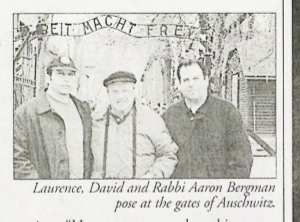
This is a picture of my father, my brother and me in front of the gates of Auschwitz during the March of the Living in the spring of 1999. In 1944, my father said goodbye there to his mother, brother and sister. He was later separated from his father at Plaszow, the camp that was near Schindler’s factory. My father was the only one to survive. To this I day I cannot watch the movie, Schindler’s List, knowing that someone in there was my grandfather, and that he was not saved. It is unbearable to think about.

My father was not liberated at Auschwitz, but he was liberated by the Americans, something for which he is eternally grateful. He returned to Germany in the 1950s, but this time as an America soldier.

Below is an unusual picture. How do you pose with your dad, a survivor of Auschwitz, at the very gate he had entered decades earlier. My brother and I decided independently on very serious looks. My dad is smiling broadly. He made it back, and he brought the next generation he and my mom, Sharon, created.

We as a people are still, and always will be, vital and alive no matter what.

Am Yisrael Chai.


Dad at Auschwitz


Here is a link to my father’s story, including video of his testimony:

http://www.ushmm.org/wlc/en/idcard.php?ModuleId=10006232


A time of darkness is when we must remember that we can be the light the world needs.

Some of my best friends are professors of Jewish history. They are wonderful people, and love what they do. However, they spend a lot of time trying to make sense of something completely illogical and improbable, namely the continued existence and flourishing of the Jewish people.

If the history of the Jewish people were a novel it would already be on the discount sale rack because the story is just so preposterous. We should have vanished into history many times over, but here we are.

The questions I would like to look at are where do we come from, why are we still here, and what are we here for?

Let’s take a quick look at the last thirty eight hundred years of Jewish history, because I want to show you that at no point was our survival as a people predictable or probable. Even our origin defies logic.

Think about Abraham and Sarah. God wants to start a new people. Who would you start with? Would you pick an elderly couple who was childless, homeless and jobless? Probably not, but that is who Abraham and Sarah were. God chose them because they were always on the side of the oppressed, the disenfranchised and those for whom society could find no use. They saw things in others that no one else did and created the family that would become the Jewish people.

Let’s go forward 1800 years. In the year 70 the Romans destroyed the Holy Temple of Jerusalem and set in motion the exile of the Jewish people around the world that would last into our own time. The reason you destroy a temple is to show that your god is more powerful than the god of the people you conquered. It would be logical and reasonable for that people to adopt the god or gods of their conquerors. We did not do that. We believed that God was not done with us, that God still loved us, though, it must be admitted that it seems at times God has a funny way of showing that love. Nonetheless, the Jews who went through that terrible period persisted in their faith.

The Jews of that time had, though, in some ways a bigger problem than the Roman occupation. The temple and its system of sacrifice was the one place for Jews that served for the expiation and forgiveness of sin. If you could not have your sins forgiven, then you could not have a relationship with God. Therefore, Judaism really should have stopped there. Instead, our sages said that there was a substitute for sacrifice that God actually preferred. That is Torah study, prayer, and acts of kindness to others above and beyond the minimum. This becomes Judaism as we know it today.

The sages created a system that was no longer dependent on a particular place, nor on an elitist priesthood, and made it accessible to every Jew, including those who went into exile. You cannot carry a temple with you, but you can carry your heart, mind and soul. Acts of kindness toward others, Jewish or not Jewish, was the equivalent of the high priest bringing the Yom Kippur sacrifice.

The idea was so revolutionary and against any conventional thinking about religion, that if they were to try it today they would be scorned by the very people who benefited from their courage.

Our sages, though, believed that we still had something to offer the world, the belief that might does not make right, and that there is no one stronger than the one that shows kindness to others, even during the worst of circumstances, even when it seems that that world has gone dark.

A thousand years later were the Crusades which destroyed so many Jewish communities of Europe. At this same time, Rashi and his students were writing some of the greatest Torah commentaries of all time, commentaries we study to this day. If you read their works, you would never guess the complete chaos of their lives. They refused to give in to that chaos, and created intellectual beauty, because they still believed in the essential or at least potential goodness of humanity.

Four hundred years later is the Spanish inquisition and the expulsion of the Jews from Spain. It is also the flourishing of Jewish mysticism, of kabbalah, as we know it. The kabbalists knew that their physical homes may be under threats from others, but the spiritual homes they built were permanent and eternal.

The most extraordinary period in all of Jewish history was of course the middle of the twentieth century. The holocaust should have meant an end to Judaism. Who would ever want to be Jewish afterward? Who would ever want to raise a Jewish family again? One of the most impressive acts of courage was the fact that so many survivors began families after everything they went through. Some of them started new families after having lost everyone in their previous family. They refused to allow the darkness to win.

Who could have imagined after such devastation, after such helplessness, that we would have our own country, or that in other countries such as America you would have more synagogues and yeshivot and day school and religious schools than in any point in our history? We should have disappeared from history, but instead we became a critical part of the world.

It sounds like a big part of being Jewish is experiencing tragedy. There are some who say that we have suffered more than anyone else in history. We certainly have had our share, but everybody suffers. The difference is that while so many other people’s have vanished or became marginal after their suffering, we have always found ways to recreate ourselves and continue to grow and develop.

None of this was predictable. None of this was logical. How did it happen? I think what we see is that throughout our history, we have always made a commitment to find meaning in life in times of tragedy and optimism in times of despair. We have always found light in the darkness, and have tried to bring that light to others. I believe that is the main reason for the Jewish people, and what we must always do if we are to continue as a people. If we do not, then Judaism becomes empty ritual and ethnic exclusivity.

The idea of revealing the light hidden in the world has been built into all aspects of Judaism since its beginning. In the Torah, the first thing that God creates is light. It cannot be sunlight, because the sun is not created until the fourth day. The kabbalists understand that light to be God’s spirit on earth. The world was a place of darkness and chaos, and God bring light and warmth to it. When humanity is cruel, then that light diminishes. When humanity is kind, then the light it revealed. Judaism, both in ritual and practice is about revealing that light.

On Shabbat we have two sets of light. Friday night when it begins, and Saturday night when it ends. The first set of lights are for you and your family at the end of the week. It is a reminder of the spark of God found within each of us, and a sign that we somehow made it through a week we may have thought we could not have. The lights of havdallah, though, are for us to bring that light with us wherever we go during the week. It is to remind us to be a source of light and comfort to everyone we encounter, including people we find difficult. It is amazing how quickly a kind word can change a challenging person into a grateful one.

The most famous lights of all are probably the Chanukah candles. This is more than bringing some light during the darkest time of the year, but remembering that we have survived the darkest moments in history and are here to celebrate. I want to share a story with you that I find so powerful. Our enemies have always tried to demoralize our leaders, because if the leader gives in, then all the followers will, too. During the holocaust a chasidic rabbi and his followers were all brought into a large warehouse. They had been in the camp for a while and were on the verge of starvation. The commandant of the camp when up to the rabbi and asked him if he would like the stick of margarine in his hand, which had enough calories to sustain a person for a number of days. All he had to do was fall on his knees and beg. The followers assumed the rabbi would refuse, but the rabbi begged. The commandant laughed, put the margarine on the floor, and ground it with the heel of his boot. He then left the warehouse to tell the others of how he had gotten the rabbi to beg. As soon as the commandant left, the rabbi told his disciples, “Don’t you know tonight is chanukah.” He pulled a button off his jacket, pulled off a few threads for a wick, gathered the margarine, and created a menorah. When the commandant returned, he found four hundred Jews singing maoz tzur. I wish I could tell you that they were all saved. They weren’t, but for that moment they showed the potential of the human spirit.

This is what it means when God tells us to be a light to the nations of the world. A light to nations, not to the world as a whole, but each nation and its individual needs. It is our task to help each country find the best within themselves. This is one of the reasons it is hard to neatly define the Jewish people. Who we are depends so much on where we live, and the people with whom we live. The goal is always the same, to make wherever we live better for all people. Every country we have lived in has been better because of us. It is no just a matter of business or science and technology. We have helped spread democracy and tolerance. We have stood up for the poor and disenfranchised often against our own economic interests. We have risked our lives for others, even those who do not love us. We have shown that loyalty to the country you live in and loyalty to your faith are not a compromise, but the fulfillment of that faith.

Jewish mysticism says that when God was creating the world he tried to contain the light in special vessels, but those vessels shattered. The shards of those vessels fell to earth, with a spark of that light attached to each broken peace.

The chasidic masters understood this as a metaphor for all the brokenness in people, that could be repaired if we found that spark of light within them.

This why so many Jews created organizations like JARC, Yad Ezra, Kadima and Friendship Circle, and have supported endless numbers of non-Jewish charities.

It is why so many Jews got involved in civil rights. For example, the late Rabbi Ernst Conrad was in Germany during kristallnacht. He ironically had just left a Wagner opera, when the riots began all around him. When he came to America, he fought for the rights of others, because he knew that the oppression of one group leads to the oppression of all.

The idea that each person has a spark of God within is even a reason that so many Jews became therapists. There is evidence that even Sigmund Freud was influenced by this idea of finding the light within the shards of the shattered vessel. Psychotherapy and other therapeutic treatments became a way of repairing the world, and saving people from the darkness of their lives.

The chasidic rabbis even extended this idea to how we think about our enemies. We must always defend ourselves, but we must still remember that our enemies are human, and have within them a spark of God as well, deeply buried as it may be. We must fight our enemies, not by our enemies standards, but by the standards of Jewish ethics. Psalm 27, the Psalm for the high holidays, says, Do not put within me the spirit of my enemies.

When we remember this we have done well. Our worst defeats have been when we have forgotten this. There is nothing greater that we can do than transform hatred into enlightenment. I believe this is the reason that we have returned to the land of Israel. It was not to build a Jewish fortress, but to help create a promised land for everyone. It is taking longer than we would like, but there is a reason that the national anthem is called Hatikvah, the hope. To be a Jew means to always have hope, even when there does not seem to be a chance. There is nothing logical about this hope, but as I have mentioned nothing about our history is logical. We might be the ones who truly see the dream of our ancestors fulfilled, that nation will not lift up sword against nation, and that humanity will no longer no war.

In every synagogue in the world there is an eternal light. It means that every generation before us defied the reality of the world, defied all the forces that tried to extinguish what was best in humanity, and chose life. It is also a challenge to us to stay strong, to not become bitter or cynical, and to embrace lives of meaning for us, our loved ones, and all of humanity even when things seem hopeless. If we do, we will be the light of a splendid and brilliant future.

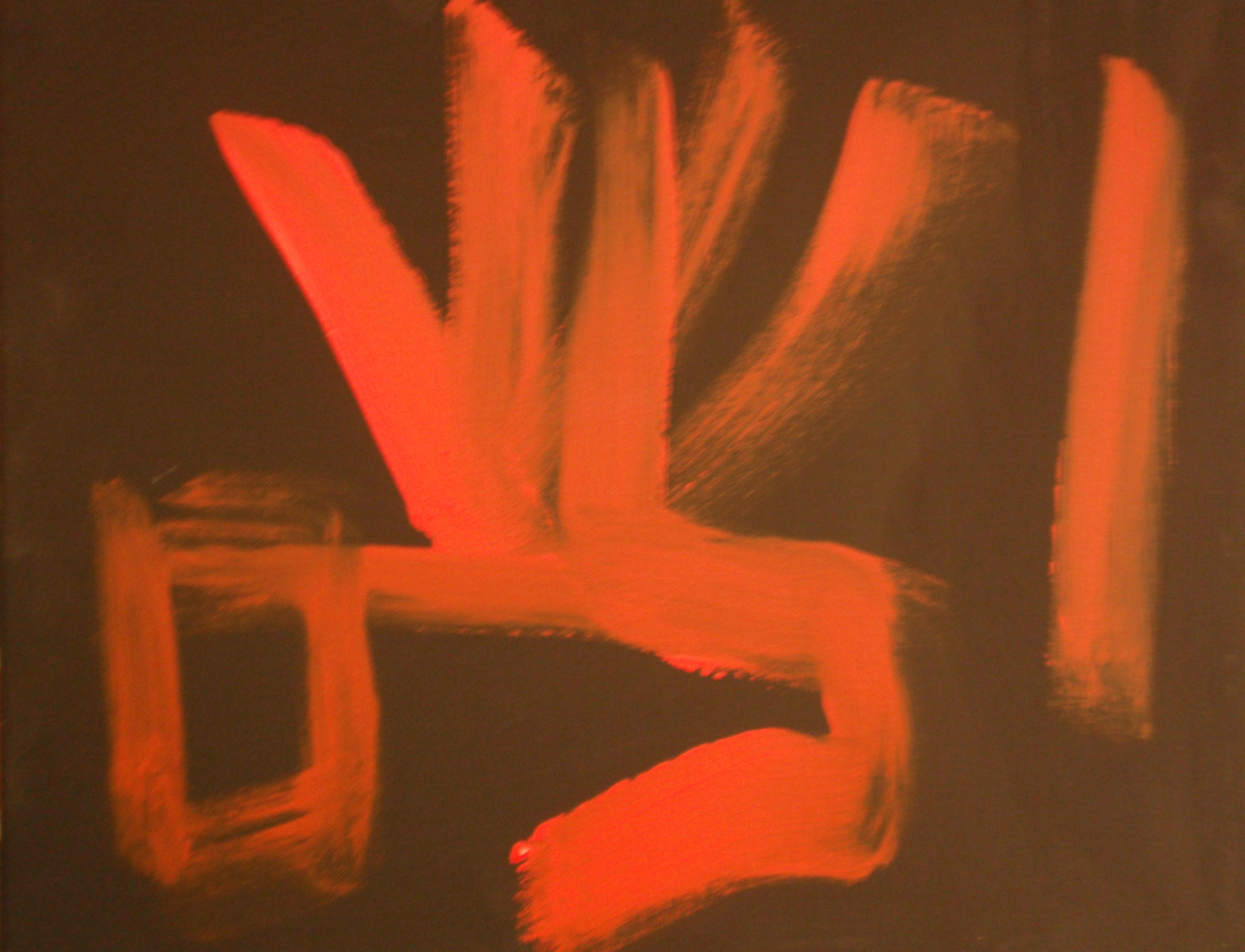
paintings plus 2010 042

Painting copyright Aaron Bergman

Seeing How Far We Have Come


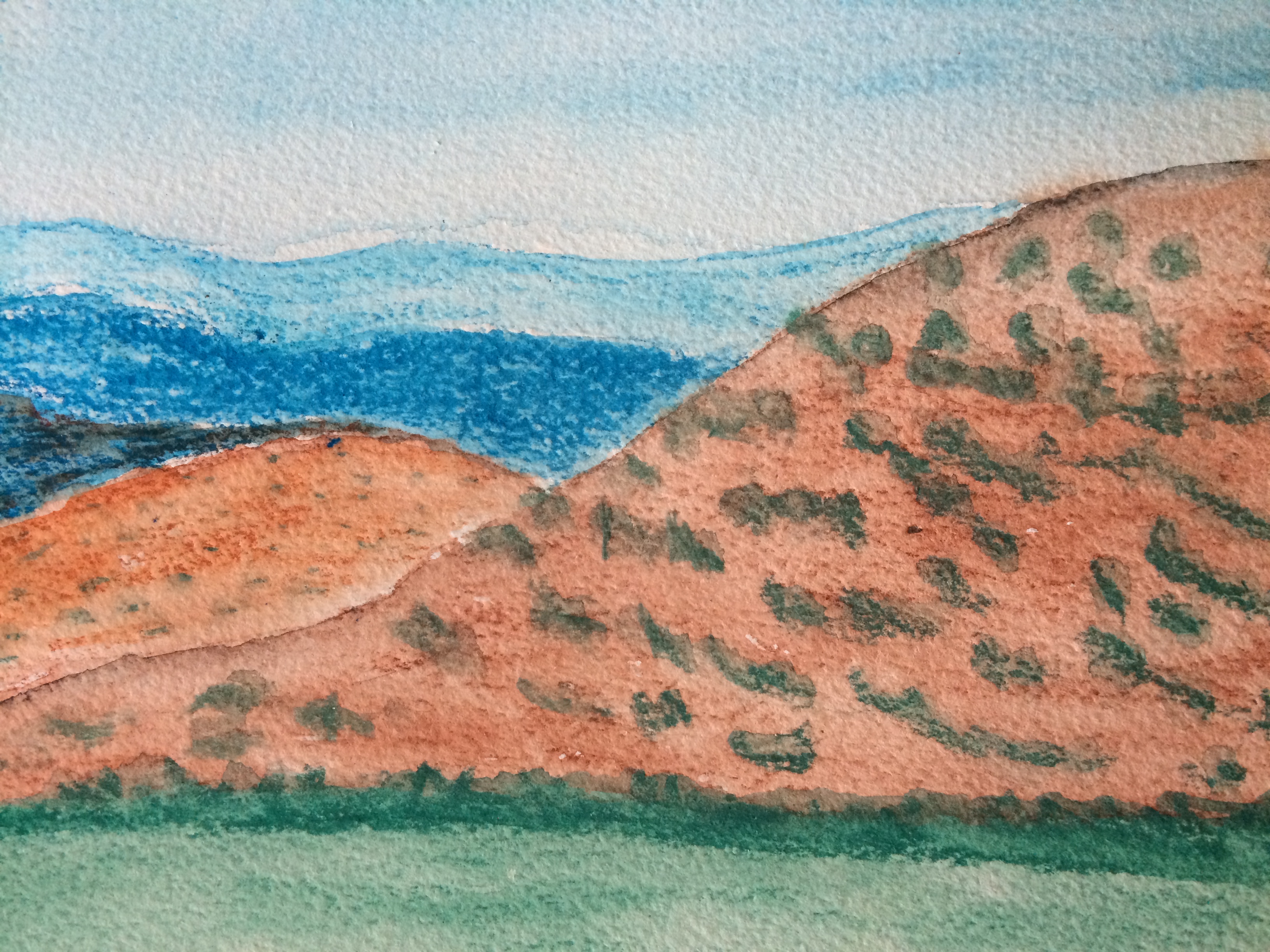
Mountain Painting

Moses was raised as a prince in the most powerful nation in the world, Egypt. He had enough power, authority, wealth, comfort and security for the rest of his life if he wanted. Instead, he gave up everything he had for one thing. That was to take a group of Hebrew slaves to freedom in a far away land that no one he knew had even seen.


The task was impossible and absurd. He took it on because it was the right thing. And he didn’t make it. He dies before bringing them into the land. We know they made it in successfully, but he only had hope and faith that they would.


He may have felt like he was going to die a failure. That is why God told him to go to the top of the mountain, and look West, North, South and East.


Just looking in two directions would have shown Moses the entire Land of Israel. Why did God have in look in all directins? Moses knew how far was left to go, but he needed to appreciate how far he had come and how far he had brought the people. His life mattered. The people never could have been where they were without him.


Dr. Martin Luther King’s final words were inspired by Moses. He was assassinated the next day.

On April 3rd, 1968, he said,

Like anybody, I would like to live – a long life; longevity has its place. But I’m not concerned about that now. I just want to do God’s will. And He’s allowed me to go up to the mountain. And I’ve looked over. And I’ve seen the Promised Land. I may not get there with you. But I want you to know tonight, that we, as a people, will get to the Promised Land. So I’m happy, tonight. I’m not worried about anything. I’m not fearing any man. Mine eyes have seen the glory of the coming of the Lord.”


The last line is a quote from the Battle Hymn of the Republic which was written in November 1861, when it was far from clear that the battle to stop slavery would be won. It celebrates the struggle for justice combined with honest self reflection that would ultimately bring real freedom to everyone.


As a people we have to remember how far we have come, and how much we have contributed and continue to contribute to the world, in often impossible odds.


We hear about the PEW report on assimilation, and the war in Gaza, antisemitism in Europe, and in the media, even locally, and we start to despair.


We lose perspective. Things are scary, but nowhere near how bad things have been in the past.


We need to go on top of the mountain and look in each direction.


In the past, antisemitic acts were started by the government. Now, most governments protect us, or at least try.


We were banned or faced quotas from so many different institutions and professions. We are now accepted pretty much everywhere.


We can express our Judaism freely in every land that is actually free. Where we can’t do that, it is usually bad for everyone.


We still work to make the world better for everyone, whether they acknowledge it or not, whether they even hate us.


When Naftali Herz Imber wrote Hatikvah in 1877, the phrase lihiyot am chofshi beartzeinu, to be a free people in our own land, was just a line written on a piece of paper in a Russian tavern. Now it is a reality.


We may not have achieved all our goals of peace and security, but we have come so far. Just look around.

Painting: copyright Aaron Bergman

Some thoughts on Israel and a few more pages from my Israel Sketch Book

I have had a daughter in Jerusalem all summer working as an intern. She comes home next week. Another daughter goes to Jerusalem for the year about two weeks later. People ask me if I am nervous. I do not hesitate for a moment, and say absolutely. That might sound like a kind of surprising response for a rabbi, but let me explain.

I am a parent. I worry when they go on dates or to the mall. I worry about everything. I love them, and when you love people it is reasonable to worry. I try not to let my worrying, though, stop them from living their lives in a good and important way.

That being said, I do worry about them in Israel, but I believe that Israel is completely and unhesitatingly worth it. We have seen a world without Israel and it is so much more terrible than anything that is happening today.

Even under a barrage of rockets, and even faced with terror tunnels that have burrowed into the consciousness of so many Israelis, Israel is functioning at a high level. People are going to work. They are helping their neighbors. They are buying food for their family and making a joyous Shabbat. They are fully and completely alive and not consumed by their fear. They are cautious, but they are not paralyzed, and they are deeply grateful for our brave boys and girls, and men and women of the IDF and are united in their support in ways that have not been seen since the 1967 Six Day War. I am in awe of the young people from our community and Adat Shalom who serve in the IDF and pray for their safety.

Rabbi Nachman said, Kol HaOlam Kulo Gesher Tzar Maod, the entire world is a narrow bridge, V’Haikar Lo L’Fached Clal, but the important thing is to not be overwhelmed by our fear. A little healthy caution and concern is appropriate, but not when it changes who you are or how you live your life.

Israel is involved in a terrible struggle. It has had to make tough decisions that few other armies have had to make. Hamas in fact knows that Israel is one of the very few countries in the entire region that will take morality into consideration when it makes a battle plan. Hamas thinks that is a weakness of Israel they can exploit. It is instead one of Israel’s greatest strengths, and one that will, I pray, allow Israel to live in peace and prosperity and ultimately be a model to the rest of the Middle East of democracy and freedom.

Israel is not perfect, but it is a miracle. There are few countries in the world like Israel. There are none that face its daily existential challenges.

So again, am I worried? Absolutely. But I am even more proud and grateful.

Am Yisrael Chai.

 photo 1 (2)photo 2 (2)photo 4 (1)

Thoughts on Memorial Day

Memorial Day 2014

I often talk about how Israel and the Jewish community have helped so many around the world.

Today on Memorial Day, I want to talk about how much America has done for the Jewish people.

From the very beginning of our country, we have been treated as full and equal citizens by our most important leaders, starting with George Washington.

This is from the letter that sent to the Jewish community in Rhode Island:

The Citizens of the United States of America have a right to applaud themselves for giving to Mankind examples of an enlarged and liberal policy: a policy worthy of imitation. All possess alike liberty of conscience and immunities of citizenship. It is now no more that toleration is spoken of, as if it was by the indulgence of one class of people that another enjoyed the exercise of their inherent natural rights. For happily the Government of the United States, which gives to bigotry no sanction, to persecution no assistance, requires only that they who live under its protection, should demean themselves as good citizens.

May the Children of the Stock of Abraham, who dwell in this land, continue to merit and enjoy the good will of the other Inhabitants; while every one shall sit under his own vine and fig tree, and there shall be none to make him afraid.

May the father of all mercies scatter light and not darkness in our paths, and make us all in our several vocations useful here, and in his own due time and way everlastingly happy.”

Abraham Lincoln extended these protections and rights. According to Harold Holzer Lincoln was the first president to appoint a Jewish military chaplain. Until then, all chaplains had to be Christian. He rescinded Grant’s Order 11 that would Jews from Union territories under the general’s control.

Rabbi Isaac Mayer Wise said at the time: “The President fully convinced us that he knew of no distinction between Jews and Gentiles and that he feels none against any nationality and especially against Israelites.”

At Congregation Shearith Israel in Manhattan the mourners’ Kaddish was recited for the first time in memory of a non-Jew. They called Lincoln “Father Abraham.”

The Jewish War Veterans were established in 1896.The group holds a congressional charter under Title 36 of the United States Code. They were the very first veteran’s group in the United States.

In the preamble to its National Constitution the purpose of the JWV is stated:

To maintain true allegiance to the United States of America; to foster and perpetuate true Americanism; to combat whatever tends to impair the efficiency and permanency of our free institutions; to uphold the fair name of the Jew and fight his or her battles wherever unjustly assailed; to encourage the doctrine of universal liberty, equal rights, and full justice to all men and women; to combat the powers of bigotry and darkness wherever originating and whatever their target; to preserve the spirit of comradeship by mutual helpfulness to comrades and their families; to cooperate with and support existing educational institutions and establish educational institutions, and to foster the education of ex-servicemen and ex-servicewomen, and our members in the ideals and principles of Americanism; to instill love of country and flag, and to promote sound minds and bodies in our members and our youth; to preserve the memories and records of patriotic service performed by the men and women of our faith; to honor their memory and shield from neglect the graves of our heroic dead.

Many people know how much the American army did to liberate the concentration camps at the end of the Holocaust, and how General Eisenhower ordered every available camera to be used to document the enormity of the tragedy. He knew in the future that people would challenge the truth of the Nazi crimes and he wanted to make sure there was an incontestable record.

What is not widely known is that the army was not just concerned about the physical well being of the survivor, but their spiritual and emotional health, as well. They commissioned a special full nineteen volume edition of Talmud especially for the survivors, call The Survivor’s Talmud.

The title page of each volume depicts a Nazi slave labor camp surrounded by barbed wire. Above it are palm trees and scenes in Israel. These images are connected by the Hebrew words: “From bondage to freedom, from darkness to a great light”.

In the first volume of the Talmud, this dedication appeared in English:

In 1946 we turned to the American Army Commander to assist us in the publication of the Talmud. In all the years of exile it has often happened that various governments and forces have burned Jewish books. Never did any publish them for us. This is the first time in Jewish history that a government has helped in the publication of the Talmud, which is the source of our being and the length of our days. The Army of the United States saved us from death, protects us in this land, and through their aid does the Talmud appear again in Germany.[1]

Each volume of the Talmud also included this dedication in English:

This edition of the Talmud is dedicated to the United States Army. The army played a major role in the rescue of the Jewish people from total annihilation and after the defeat of Hitler bore the major burden of sustaining the DPs of the Jewish faith. This special edition of the Talmud published in the very land where, but a short time ago, everything Jewish and of Jewish inspiration was anathema, will remain a symbol of the indestructibility of the Torah. The Jewish DPs will never forget the generous impulses and the unprecedented humanitarianism of the American forces, to whom they owe so much.

(Signed) Rabbi Samuel A. Snieg, Chief Rabbi of the U.S. Zone

America tried to return Jewish books and ritual items after the Holocaust. The army hired a scholar to go to Europe and identify and catalogue all these books. Most of the original owners had perished, and the communities had been wiped out.The books were given to the Jewish community in America or housed at the Library of Congress.

The Library of Congress now has more than half a million pieces of Judaica and Hebraica, the largest collection outside of Jewish institutions.

There would be no state of Israel without America’s enduring friendship. No other country has consistently supported Israel or has recognized its right to survive.

America is also the place of the greatest Jewish creativity of the last several hundred years, including egalitarian approaches to prayer and community. We have been free to create our own communities, while still being fully loyal citizens.

Veterans have given so much for all of us to be free. However, we as a country have failed them in so many ways. Tremendous percentage of those who are homeless or unemployed or facing psychological or physical traumas are veterans. This is unacceptable. Support groups like Wounded Warriors. Call your representatives and demand better treatment.

I want to share the names of the most recent casualties, to at least put a name on the people who defend us.

The Department of Defense announced today the death of soldiers who were supporting Operation Enduring Freedom.

Spec. Adrian M. Perkins, 19, of Pine Valley, California, died May 17, in Amman, Jordan, from a non-combat related injury.

He was assigned to 1st Battalion, 67th Armor Regiment, 2nd Brigade Combat Team, 4th Infantry Division, Fort Carson, Colorado.

Command Sgt. Maj. Martin R Barreras, 49, of Tucson, Arizona, died May 13, in San Antonio Military Medical Center, Joint Base San Antonio, Texas, from wounds suffered on May 6, in Harat Province, Afghanistan, when enemy forces attacked his unit with small arms fire.

He was assigned to the 2nd Battalion, 5th Infantry, 3rd Brigade Combat Team, 1st Armored Division, Fort Bliss, Texas.

I pray that those who served will all get the help and recognition they deserve.

I pray that the families of all those who gave their lives feel our eternal gratitude and respect.

The Real Question of Passover


According to a recent study of Jewish observance, Chanukah is the holiday that more Jews observe than any other. The Passover Seder, however, is probably the most celebrated ritual in Jewish life that does requires more than lighting candles and frying potatoes. So many people have a Seder that we do not realize what a revolutionary idea it is.


To the best of my knowledge, the Seder is the first significant religious event that took place originally at home and not in a temple. It is still primarily home based. The Sedarim not done in the home are based on the ones that are.


In the history of religion, not just Judaism, the most important rituals took place in public and were performed exclusively by the religious leadership on behalf of the people. They were completely controlled and supervised by the priesthood.


The first Seder took place in Egypt, the night before the Exodus. It took place in the homes and was conducted by the people who lived there. It would have been very dangerous to conduct it in public, perhaps, but if God had wanted it that way I am there could have been a miracle allowing it to happen.


The Torah instead empowers the people to have a discussion about freedom that makes sense to them, without outside interference or criticism.


Even later, the high priest had no more standing at a Seder than anyone else.


The Seder was the beginning of the idea that any space could be sacred and holy if the people in it made it so.


It is to remind us of our responsibility to uncover and rediscover the inherent holiness of all places.


Let’s look at some of the rituals. First, the wine. All Jewish holidays and Shabbat have a blessing over wine. On Passover, there is more than one cup. There was a disagreement whether there should be four cups or five. The rabbis decided to compromise and drink four, leaving a fifth on the table, for when Elijah would come some day and decide. The wine, then, is a metaphor for the importance of compromise. That is how we begin.


The motzi, the blessing we say over challah, is exactly the same as the one we say

over matzah. Challah is soft and chewy. Matzah is not. Both, though, are nutritious and will sustain us. The Seder teaches us to be grateful for the things in our lives that we take for granted or feel we are entitled to. We learn that everything can be delicious if we appreciate how lucky we are to have it.


The Haggadah is important for what it says, but maybe even more so for who says it. For many centuries in many cultures there was the idea that children should be seen but not heard, that they were merely empty vessels in which the adults would pour in the knowledge they felt was necessary. It is amazing to me that our sages thousands of years ago understood that education can only begin when the child is genuinely curious, and that the adults teach to the interest and level of the child. It also speaks to the importance of listening to everyone in the house, both the most powerful and the most vulnerable .At the Seder everyone is heard, and everyone deserves a good and thoughtful answer.


Preparing for Passover is a reminder that we can live every moment in a sacred and holy place. Cleaning for Pesach means getting rid of all those things that prevent us from seeing that.


What can we each do to make our homes into a place of freedom and joy in responsibility? That is the real question that we ask at the Seder.


Lincoln and the Maccabees

Abraham Lincoln was the first to declare Thanksgiving a national holiday, almost exactly 150 years ago. Thanksgiving had been celebrated in some communities in America since 1607, but Lincoln was the first to make it a holiday for the nation itself.

The language of the declaration, written for Lincoln by Secretary of State William Seward, is powerful and poetic. It said, “And I recommend to them that while offering up the ascriptions justly due to Him for such singular deliverances and blessings, they do also, … commend to his tender care all those who have become widows, orphans, mourners or sufferers in the lamentable civil strife in which we are unavoidably engaged, and fervently implore the interposition of the Almighty Hand to heal the wounds of the nation and to restore it as soon as may be consistent with the Divine purposes to the full enjoyment of peace, harmony, tranquility and Union.”

Lincoln did not wait for the end of the Civil War to offer gratitude and ask for kindness toward those in need on both sides. He delivered it in the middle of a war that would continue for another year and a half.

The story of Chanukah takes place in the middle of the war, not the end. It celebrates the Maccabees reclaiming and rededicating the Holy Temple, but the war for independence took another dozen years.

According to the first book of Maccabees, which was written around the time of the Chanukah story in the 2nd century BCE, The Maccabees declared eight days of thanksgiving, even though one would have been fine. Maybe the oil lasted for eight days because they were willing to celebrate those eight days. The celebration was giving thanks for getting the Temple back and for being able to resume their full lives as Jews.

There are only two mitzvot, two commandments, on Chanukah. The first is to light the lights, and if possible place them so people outside can see them. Even in the darkness moments of our lives it is possible to find light and goodness and share that with the world.

The other is to give thanks. Thanks for everything, for the good things, and for the opportunity to help fix the bad, and gratitude for all those who struggled and gave their lives so we could be free.

This is what Lincoln meant in his dedication of the cemetery at Gettysburg almost exactly 150 years ago, too.

“It is rather for us to be here dedicated to the great task remaining before us — that from these honored dead we take increased devotion to that cause for which they gave the last full measure of devotion — that we here highly resolve that these dead shall not have died in vain — that this nation, under God, shall have a new birth of freedom — and that government of the people, by the people, for the people, shall not perish from the earth.”

This is the spirit of the Maccabees.

The struggle is never over. The world is still a dangerous mess. If we wait for everything to be settled and perfect before we celebrate we never will. The celebration must include gratitude for our lives and dedication to making the world better.

We have shown the ability to celebrate during times of grief and chaos, and to still remember who we are, both our identity and our values as Jews.

What we as a people can do is remind the world that it is always possible to still be fully human, and that goodness can be found in unlikely places. And that it is our responsibility to help others live lives they can be grateful for, and to help protect the world from those who want to destroy everybody’s liberty.

If we do so, then we, as Lincoln said, shall not perish from this Earth.

Whose dreams do we want our children to have? Thoughts on Jacob and a coat

“Joseph and the Amazing Technicolor Dreamcoat” is probably the most famous musical based on the Hebrew Bible.  It might be the only one, though I would love to see what Sir Andrew could do with Leviticus. The songs in “Joseph” were delightful.  The story was fun. Even Donny Osmond was perfect (maybe because he has so many siblings). The only problem with the story is that the biblical Joseph never had a coat of many colors.  Jacob gave him a Ketonet Passim, according to the Midrash a special long-sleeved or delicate coat; a coat not necessarily colorful, but highly symbolic.

In Biblical times, such a coat seemed to be a sign of tribal leadership.  Joseph’s brothers were not upset that their father gave Joseph a fancy coat.  They were upset that Jacob wanted to make Joseph, the youngest brother, the head of the tribe, bypassing the normal order of tribal succession.  Within a short time of receiving this coat, Joseph begins to dream that he is superior to both his brothers, and then his parents. It is small wonder that Joseph’s brothers try to get rid of him.

I have often wondered if Joseph would have had these same dreams had his father not given him the coat of leadership.  The coat itself seemed to cause Joseph’s dreams, dreams that got him into a great deal of trouble.  Jacob, in a sense, gave Joseph dreams that Joseph was not able to handle.  Joseph spent the next twenty years of his life recovering from his father’s plans.

Everyone is entitled to his or her own dreams. I see so many situations in which the parents are trying to live out their own lives through their children. Maybe they did not have the business or athletic success they would have liked, and so try to have their children make up for it. Sometimes the parents in fact did have great success and believe that their children, with enough effort, can be just as successful. If the child has different plans, this can lead to great stress and tension on the relationship, even if everyone really has the best of intentions.

If we cause dreams that cannot be lived up to, we risk inflicting a great deal of harm on our loved ones.  As Bruce Springsteen sang in “The River”, “Is a dream a lie if it don’t’ come true/ or is it something worse?”  We have to ask ourselves what kind of dreams we are giving to others.  Do we make them feel safe and secure?  Do we give them appropriate levels of responsibility?  Are we generous and kind to those who may not be our favorites?  Do we have reasonable career and financial expectations of our loved ones?  If we cannot answer these questions with a yes, we may be causing nightmares instead of nurturing dreams.

Let us try to make sure the dreams we give our loved ones bring them comfort and peace of mind.

The World is a Prayer, You are a Prayer-Texts and Meditations for Sukkot

Sukkot is a reminder that  there is not difference between nature and ourselves. We are part of the world, and made of the world. These texts and meditations will help provide a sense of connections between our physical and spiritual selves, leading to a greater sense of wholeness and peace.

Rabbi Nachman of Bratzlav’s Prayer

Master of the universe, grant me the ability to be alone;

may it be my custom to go outdoors each day,

among the trees and grasses, among all growing things,

there to be alone and enter into prayer.

There may I express all that is in my heart,

talking with God to whom I belong.

And may all grasses, trees, and plants awake at my coming.

Send the power of their life into my prayer,

making whole my heart and my speech

through the life and spirit of growing things,

made whole by their transcendent Source.

O that they would enter into my prayer!

Then would I fully open my heart in prayer, supplication, and holy speech;

then, O God, would I pour out the words of my heart before Your presence.

Sukkot Prayer By Rabbi Elihu Gevirtz, 2012*

(Based on Rebbe Nachman of Breslov’s Likutey Moharan Helek I, Torah #5:2.)

Allow me to sit in the sukkah without withholding joy

Allow me to sit in the makom of your presence

Let me experience your joy

Let your joy be mine

And mine by yours

May our joy unify the elements of your essence.

Rabbi Nachman of Breslov’s teaching of AZAMRA

(Likutey Moharan I:282)

Azamra l’Elokai be-odee!

“I will sing to my God as long as I live!” (Psalm 146:2).

Find the good in others…

KNOW that you must judge all people favorably. This applies even to the worst of people. You must search until you find some little bit of good in them. In that good place inside them, they are not bad! If you can just find this little bit of good and judge them favorably, you really can elevate them and swing the scales of judgment in their favor. This way you can bring them back to God

This teaching is contained in the words of King David in the Psalms: “And in just a little bit (ve-OD me-at) there’s no sinner; when you think about his place, he won’t be there” (Psalm 37:10). King David is teaching us to judge everyone favorably. Even if you consider someone to be totally bad, you must still search until you find some little bit of good in him. There in the place of this tiny bit of good, that person is not bad! This is the meaning of the words, “And in just a little bit there’s no sinner…” In other words you must seek out the little bit of good that is still in him. For in that place he is not a sinner. Maybe he’s a bad person. Even so, is it really possible that he is totally devoid of even the slightest modicum of good? How could it be that all his life he never once did anything good? By finding one tiny good point in which he is not bad and thereby judging him favorably, you really do raise him from being guilty to having merit. This will bring him back to God. “In just a little bit there’s no sinner!”

By finding this little bit of good in the bad person, this place inside him where he is not wicked, through this “…when you think about his place, he won’t be there.” When you examine his “place” and level, “he won’t be there” in his original place. For by finding some little bit of good in him and judging him favorably, you genuinely raise him from guilt to merit. And “when you think about his place, he won’t be there”. Understand this well.

Find the good in yourself

You must also find the good in yourself. A fundamental principle in life is that you should always try to keep happy and steer well away from depression. When you start looking deep inside yourself, you may think you have no good in you at all. You may feel you are full of evil, and the negative voice inside you tries to make you depressed. Don’t let yourself fall into depression. Search until you find some little good in you. How could it be that you never did anything good in your whole life?

When you start examining your good deed, you may see that it had many flaws. Maybe you did it for the wrong reasons and with the wrong attitude. Even so, how could it be that your mitzva or good deed contains no good at all? It must contain some element of good.

You must search and search until you find some good point inside yourself to give you new life and make you happy. When you discover the good that is still in you, you genuinely move from being guilty to having merit. Through this you will be able to come back to God. “And in just a little bit there’s no sinner; when you think about his place, he won’t be there.”

Earlier we saw that we have to judge other people favorably, even those who seem totally bad. We must search for their good points in order to swing the scales in their favor. The same applies to the way you look at yourself. You must judge yourself favorably and find the good points that still exist in you. This way you won’t fall into despair. The good you find inside you will give you new life and bring joy to your soul.

Guided Meditation for Sukkot by Rabbi Aaron Bergman

-Breathe with your nose into the belly, push out with diaphragm. Hold for a few seconds. Concentration comes during the holding of breath. Breathe out slowly through the nose (first few breaths should be through the mouth). Repeat every few breaths. Allow any thought to arise. Greet the thought with curiosity, but not judgment. Where are these thoughts located? Your mind is your ally. What is it trying to teach you?

The sukkah is made completely from nature. So are you. Think of yourself as fully in the world and the world fully within you.

Think about the sukkah at night. It is very dark, but it is possible to see some light. What is that light for you? Realize that the light is within you.

Realize that you are the source of light and that the world only appears dark sometimes.

Breathe quietly for a few more minutes.

A Guided Meditation for Emotional Healing during the High Holidays

Gates of Repentance

A (Self) Guided Meditation

One of the central images of the High Holidays is that of Heavenly Gates open to our prayers.

Gates can open to the outside and new possibilities. Gates can close us off from what is within.

Repentance can cleanse us spiritually or make us feel guilty. It is an answer to the difficult questions about ourselves and our lives that we have been avoiding.

This meditation is not necessarily relaxing, but it can bring a feeling of catharsis, wholeness, and spiritual cleansing. This is not meant to be done in one sitting. Pick a section to work on, preferably in the given order, but you can decide for yourself. Spend no more than fifteen minutes at a time in the beginning. Allow yourself another fifteen minutes to gather yourself together. This is very emotional.

  1. Sit comfortably.

  2. Breathe normally. Do not do anything special. Just be aware of your breathing. You will naturally fall into the right rhythm.

  3. Visualize a gate. What does it look like? Is it inviting? Is it threatening? Why do you think this is the image that came to you? Think of a gate in which you can meet anyone past, present, or future, a gate in which you can meet yourself as a child or as an adult, the person you thought you would be, the person you wished you would be, and the person that you are. Where is God in this gate?

    1. Visualize all the people with whom you have had a relationship that brings you joy. What do you want to say to them? Say it in your mind if you are with others and do not feel comfortable. Say it out loud if you are alone. Remember all the wonderful things they did for you. Why did they do it? Did you feel worthy of their love? Why or why not

    2. Visualize the people with whom you have a challenging relationship, and are still alive. There may be some overlap with the first group.What do you want to say to them? Is there a fault? What do you think happened in the lives of these people that made them so difficult? Can you feel any empathy or understanding? What is your share in the difficulty? Speak to them in your mind. No one else will hear. Can you share any of this with these people? Why or why not? What would forgiveness look like, of each other, or just one to the other? If forgiveness is not possible, what would letting go look like? Can you get on with your life if no forgiveness is possible?

    3. Do the same as above, but with those who are no longer living, or capable of response. This is a lot harder emotionally, but the conversation may provide healing. People’s spirits are eternal. I am not suggesting that the person’s spirit is necessarily listening, but somehow people’s presences can be felt in times of extreme emotion. This is a matter of personal belief.

    4. Visualize yourself as a child. What would you like to have told them? It is too late to follow that advice? Whose life did you wind up living? What turned out as expected? What did not, but was worse or better than you thought. What do you want to say to the you of the future? Which you do you want to see walking through the gate at the end of your journey. How are you going to get to that point?

    5. Where is God in your life? Share all the anger and sorrow and joy and appreciation.

Do this exercise at least once a week. Sometimes it will feel comfortable. Sometimes it will be very uncomfortable. Stick with it for several weeks. You will develop insights that will allow you to start healing.